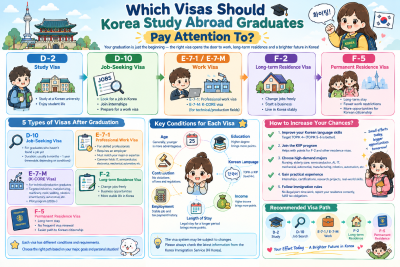
Proposed reforms include reviewing exemptions from financial documentation requirements for eligible students with TOPIK Level 4 or KIIP Level 4, alongside measures to extend post-graduation job-seeking opportunities.
On October 7, 2026, the Ministry of Justice of the Republic of Korea announced the results of discussions on improving the visa system for international students, as the country prepares for an era of 400,000 foreign students.
The discussions were conducted through the Public-Private Council for Improving the Visa System for International Students, established on April 20, 2026. Over approximately five months, the council explored policy measures aimed at shifting the focus from simply attracting international students to supporting their academic development, employment prospects, and long-term contribution to Korean society.
The proposed improvements cover financial documentation, part-time employment, post-graduation job seeking, and stronger links between education and employment.
The proposed measures include reviewing exemptions from financial capacity documentation for certain international students who meet specified Korean-language proficiency requirements, including TOPIK Level 4 or KIIP Level 4.
The objective is to reduce administrative burdens for eligible students while maintaining appropriate safeguards in the visa screening process.
However, these exemptions remain subject to the final eligibility criteria and implementation guidelines. Meeting a particular language proficiency level should not be assumed to automatically exempt an applicant from financial documentation requirements.
The government is also considering improvements to the part-time employment system for international students.
Discussions include reviewing Korean-language proficiency requirements and related conditions, with KIIP Level 3 mentioned in the context of the proposed improvements.
Any changes will depend on the final regulations. International students must continue to comply with the employment permission procedures, working-hour limits, and other requirements applicable to their visa status.
Students should confirm the latest rules before beginning any part-time employment.
Another key area under review is the period of stay available to international graduates seeking employment in South Korea under the D-10 job-seeking visa.
The proposed direction includes allowing eligible graduates who meet the relevant Korean-language requirements to stay for up to three years for job-seeking purposes.
For applicants who do not meet the specified language requirements, the framework discussed includes an initial stay of one year, with potential six-month extensions, subject to a proposed maximum of two years.
These periods and conditions should be understood as proposals under review, not as confirmed entitlements. International graduates should consult the latest official immigration guidance before making decisions about their employment or residence plans.
The discussions also addressed the possible use or expansion of deposit-based arrangements for certain categories of international students.
The aim is to improve the management of financial requirements while maintaining appropriate safeguards for students and educational institutions.
The eligible student categories, deposit amounts, and detailed procedures must be confirmed through official implementation guidance. No single deposit amount should be assumed to apply to all international students.
South Korea is seeking to build closer connections between international education and the domestic labor market.
Proposed measures include exploring pathways for eligible international graduates, particularly those with qualifications in science, technology, engineering, and mathematics (STEM), to transition from student status toward employment and longer-term residence.
A proposed K-TECH Master pathway has also been discussed in connection with qualified STEM master’s graduates and a potential transition from D-2 student status to F-2 residence status.
Such transitions would depend on the final program requirements and each applicant’s qualifications. Graduation alone would not automatically grant eligibility for F-2 status.
Alongside efforts to attract international students, the government is considering measures to strengthen oversight of educational quality and the responsibilities of institutions admitting foreign students.
The broader policy direction emphasizes not only student recruitment but also academic progress, lawful residence, career preparation, and sustainable integration into Korean society.
For prospective students, this reinforces the importance of selecting an institution that aligns with their academic background, language proficiency, financial circumstances, and long-term goals.
For prospective students from around the world, these proposed reforms may create new opportunities in the future. However, it is important to distinguish between measures under discussion and regulations that have officially taken effect.
Before applying to study in South Korea, international students should:
Visa requirements and eligibility conditions may vary depending on the applicant’s circumstances, visa category, educational institution, and the regulations in force at the time of application.
South Korea’s proposed visa reforms reflect a broader policy shift toward supporting international students throughout their educational journey—from admission and study to employment and potential long-term residence.
As the country works toward its goal of welcoming 400,000 international students, prospective applicants should follow official announcements, prepare their documentation carefully, and make informed decisions based on confirmed requirements.
Official reference: Ministry of Justice of the Republic of Korea, announcement dated October 7, 2026, concerning improvements to the visa system for international students in preparation for the 400,000-student era.
For the latest confirmed requirements, consult the Ministry of Justice and the relevant Korean immigration authorities. Measures that remain under review should not be interpreted as policies already in effect.