Studying in South Korea is not simply about choosing a university, selecting a major, or completing an academic program. For international students who wish to work, reside long-term, or eventually obtain permanent residency in South Korea, understanding the post-graduation visa transition process is essential.
In reality, many students and parents focus primarily on tuition fees, scholarships, academic programs, and admission requirements when considering studying in South Korea. However, the opportunity to remain and work legally in the country after graduation depends on several factors, including visa eligibility, academic qualifications, Korean language proficiency, employment opportunities, and immigration regulations in effect at the time of application.
Simply put, graduation is only the beginning. International students who wish to seek employment, work legally, obtain long-term residency, or pursue permanent residency in South Korea should understand the following visa categories:
Each visa serves a different purpose at different stages. Some visas allow graduates to seek employment, others permit professional employment, while certain residence statuses represent long-term goals that require applicants to meet specific conditions regarding residency, income, Korean language proficiency, and compliance with immigration laws.
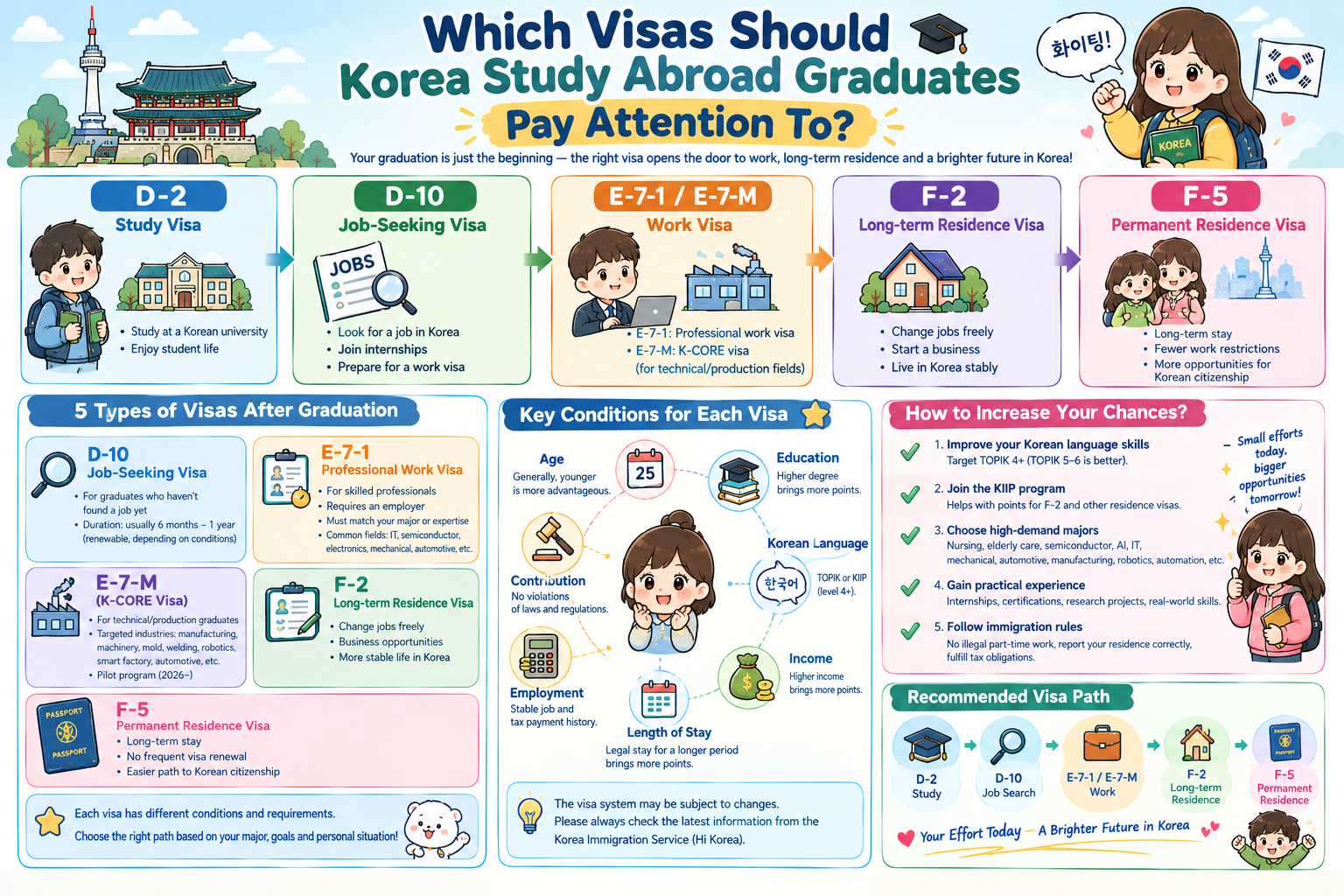
The D-10 visa is intended for international students who have graduated from educational institutions in South Korea but have not yet secured full-time employment, or who are preparing the necessary documents to transition to an employment visa.
It is generally considered a transitional visa between studying and entering the Korean workforce.
The D-10 visa is generally used for the following purposes:
According to improvements to the job-seeking visa system announced by South Korea’s Ministry of Justice, the maximum permitted period of stay under the D-10 category for eligible graduates of Korean educational institutions has been extended.
However, international students should understand that obtaining a D-10 visa does not automatically guarantee permission to remain in South Korea for the maximum possible period.
Visa issuance and extensions depend on individual circumstances, supporting documents, job-seeking plans, actual job-search activities, and evaluations conducted by immigration authorities.
Therefore, students are encouraged to prepare their employment plans, application documents, Korean language skills, and career goals before graduation.
The E-7-1 visa is a subcategory of the E-7 visa classification, generally intended for foreign nationals working in professional occupations that require specific knowledge, technical skills, or specialized expertise.
It is one of the employment visa categories frequently considered by international students after graduating from educational institutions in South Korea.
International graduates generally need to satisfy several requirements to qualify for an E-7-1 visa, including:
International students often consider the following academic and professional fields when planning a potential transition to an E-7-1 visa:
The list of occupations eligible for E-7 visas may change in accordance with current regulations.
Therefore, students and educational consultants should verify the official list of eligible occupations at the time of application before making academic or career decisions.
The E-7-1 visa offers several potential advantages for international graduates:
An important point international students must understand is that graduating from a university or college in South Korea does not automatically qualify them for an E-7 visa.
Some students mistakenly believe that graduation from a Korean institution guarantees eligibility to change their visa status to E-7. However, this is not the case.
To transition to an E-7 visa, applicants must generally secure employment with an eligible company, work in an approved occupation, meet the applicable salary requirements, and submit documentation that satisfies immigration regulations.
Therefore, when selecting a major for studying in South Korea, students should consider not only tuition fees and admission requirements but also future employment opportunities and potential visa transition pathways after graduation.
The E-7-M visa, also known as the K-CORE Visa, is a new visa policy announced by South Korea’s Ministry of Justice to support the training, employment, and long-term retention of international students graduating from designated technical education programs.
K-CORE is designed to connect technical education at Korean junior colleges with employment opportunities at regional companies, particularly in manufacturing and technical industries facing labor shortages.
International students should note that the E-7-M pathway is not universally available to all educational institutions, technical majors, or international graduates in South Korea.
The policy is linked to specifically designated technical departments or educational programs.
Therefore, before selecting a university, college, or academic major, students should confirm whether the institution and program are officially included in the designated K-CORE initiative.
The E-7-M pathway is particularly relevant to students enrolled in practical technical education programs related to fields such as:
According to the announced policy framework, graduates from designated technical education programs are expected to satisfy important requirements, including:
Specific eligibility standards may be revised depending on the year, program requirements, and guidance issued by immigration authorities.
The E-7-M program aims to:
Compared with conventional E-7 visa pathways, the E-7-M program has been specifically designed for students undertaking practical technical education through designated programs.
For international students interested in technical training, manufacturing-related employment, and long-term residence in South Korea, the E-7-M pathway may represent an important opportunity.
However, participation in the program does not guarantee visa approval or a successful change of immigration status.
Applicants must still satisfy the relevant academic, language, employment, salary, and immigration requirements in effect at the time of application.
| Category | E-7-1 | E-7-M |
|---|---|---|
| Visa classification | Professional employment category under E-7 | Technical employment pathway under the K-CORE program |
| Target applicants | Foreign workers with relevant expertise, academic qualifications, or professional experience | Graduates of designated technical education programs |
| Occupational fields | Professional occupations approved under E-7 regulations | Primarily technical, manufacturing, and regional industrial sectors |
| Applicable institutions | Not restricted to a specific educational program, but visa requirements must be met | Limited to officially designated institutions, departments, or programs |
| Main objective | Employment of qualified professionals | Education → Regional Employment → Long-Term Residence |
| F-2 pathway | Possible if the applicant meets the relevant requirements | Includes a pathway supporting F-2 applications after specified employment conditions are fulfilled |
The F-2 visa is a long-term residence status available to foreign nationals who meet the relevant eligibility requirements established by South Korea’s Ministry of Justice.
For international students, obtaining an F-2 status may become a long-term objective after graduation, transitioning to an employment visa, gaining lawful work experience, and satisfying the applicable requirements.
The F-2 visa is an attractive option for many foreign nationals because certain F-2 categories offer greater residential stability than conventional employment visas.
Potential advantages include:
Depending on the F-2 subcategory, immigration authorities may consider various factors, such as:
For certain points-based F-2 categories intended for skilled professionals, periods spent under D-2 student status or D-10 job-seeking status may not be counted in the same way.
Therefore, applicants should carefully review the eligibility conditions of their intended F-2 category before developing a long-term immigration plan.
The F-5 visa grants permanent resident status in South Korea and is one of the long-term immigration goals pursued by many foreign workers.
Foreign nationals who obtain F-5 status can establish a stable life in South Korea with fewer restrictions than those generally associated with temporary residence categories.
The F-5 visa offers several important advantages:
Applicants seeking F-5 permanent resident status must meet requirements that may relate to:
The F-5 visa is generally not a status that international students can obtain immediately after graduation.
Instead, permanent residency is typically a long-term objective requiring careful preparation through several stages, including education, job seeking, employment visa transitions, income accumulation, maintenance of lawful residence, and establishment of a stable immigration record.
Graduation in South Korea is not the end of the journey. It is the beginning of a professional career and potentially a long-term residency pathway.
International students who focus exclusively on selecting a university without considering their major, employment prospects, and possible visa transitions after graduation may face significant challenges when attempting to remain and work in South Korea.
A well-planned pathway should take the following factors into account:
Studying in South Korea involves much more than gaining admission to an educational institution and completing a degree.
For international students who wish to pursue employment, long-term residence, or permanent residency in South Korea, understanding the available post-graduation visa categories is essential.
Visas such as D-10, E-7-1, E-7-M, F-2, and F-5 serve different purposes at different stages of an international student’s academic, professional, and residency journey.
By understanding the relevant eligibility requirements and planning ahead, students can make more informed decisions regarding their academic majors, application documents, career opportunities, and long-term future in South Korea.
However, immigration regulations may change over time. Therefore, before submitting an application or developing a specific immigration pathway, students should verify the latest information provided by Korean immigration authorities or consult qualified immigration professionals.
Contact us for personalized guidance on studying in South Korea and planning a suitable post-graduation visa pathway based on your academic background and individual circumstances.